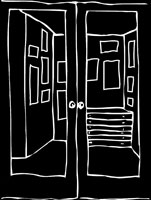
FIGURE? GROUND.
The figure/ground duality is basic to the act of seeing and to the
act of drawing. Starting with a blank sheet of paper, the artist puts
down any sort of mark, and one’s eye immediately reads it as
a figure (of something or someone) against a space, the one defining
the other. The degree of abstraction or specificity is dependent on
the nature of the mark--one line made in one stroke can be quite representational
or suggest little more than itself—and on the perception of
the viewer. The artists in this exhibition, culled solely from the
Kentler’s flat files, toy with the viewer’s perceptual
expectation of a figure/ground distinction when looking at flat art,
or they explore completely the idea of surface/support. Some tease
out the ambiguity that lies in between, in works that hover somewhere
near pattern but are, on the other hand, not repeatable.
One could characterize these different emphases as degrees of spatiality.
David Lantow’s ambiguous, sci-fi like creatures/vessels are
unnamable but, rendered with traditional gradations of light to dark,
exist in a familiar, realistic, or a least, imaginable space, though
whether its macro- or microcosmic is left up to us. Sherae Rimsey
plays more teasingly with flatness. Her reddish washes coalesce into
forms but remain decidedly planar against the paper. Here, degrees
of flatness become infinitesimal, and the degree of abstraction more
extreme. Nonetheless, these things she draws remain separate from
the support and read against it. This plays with the kind of mediated
perception one experiences through artificial viewing devices—microscopes
or telescopes, for example, which flatten out imagery even as they
delve deeply into space in one direction or the other. Jirí
Kornatovsky is much in the macro end of the spectrum, by shear physical
size alone. His huge drawing, whose presence in the Kentler's space
partly inspired the idea of the show, is an exploration of contour
and its essence in shaping form, but the presence of the form becomes
surreal through both its large scale and the fact that it’s
a vehicle for the elemental curving roundness on which dimensional
believability rests in picture making.
Hovey Brock
Hovey
Brock’s gorgeous traces of light and color in watercolor washes
play with line in a different way. One endless thick strand creates
a hovering, atmosphere-eaten body that seems on the verge of being
subsumed into the whiteness of the paper around it. He creates a fat
line that seems to define a form while the line itself teeters on
the ephemeral.
Figure/ground distinctions are essential for written language, and
artists have long used this fact to explore its ambiguity. James Jack’s
Evolution of a Mark suggests a form of writing, and the title
evokes the fact that traditional drawn marks are themselves a language
and can be reinvented by their user, whether artist or spectator.
Less ambiguous is Robert Schwinger’s The Ring, a strong
piece of graphic design whose luminosity and visual vibration enlarge
its letterlike form. Ernst Benkert’s Burned Out Churches
are also signlike, of a more symbolic type, reducing the form of a
house or shelter to base elements instantly recognizable to western
eyes, at least; they show language’s roots in basic drawing—we
could easily imagine them becoming letters in some nascent linguistic
system.
Susan Schwalb’s meticulous metalpoint drawings are, on the other
hand, firmly rooted in ground. Although her beautifully mottled and
modulated striations sometimes evoke a tablet or staff, as for musical
notations, her drawings assert the materiality of her medium and its
surface resistance. Paradoxically, the relentless emphasis on surface
often evokes a sense of infinite space and continuity. Such expansiveness
is especially evident in the work of Richard Howe, whose luminous
pastels seem to take on the evocation of different types of light
as their subject. The powdery pastel medium defies the flatness of
the paper, suggesting instances of enveloping weather and atmosphere.
Stephanie Brody-Lederman uses the idea of ground in a different way,
creating what looks like the fragment of an urban wall, a representation
of a very used, gritty cultural site, the representation of a background
for life (a wall in a city) rather than the ground for art.
Artists who play more ambiguously with a floating, indeterminate space
develop ways to stretch it out and manipulate it, sometimes through
a process that seems linked to the subconscious, such as Elaine Smollin’s
smudgy charcoal work. She reaches an equivalency between mark and
surface/support that suggests an evolving dimensionality. In Alicia
Wargo’s collaged structures, the linearity essential for drawing
and essential for the mathematical rendering of space with precision
comes through cut and colored rectilinear forms. The collaged nature
of the material is always a means to emphasize the flat, as it does
here close up, yet the thin linearity of her build up of forms suggests
mathematical recession—although one which makes the works seem
like construction drawings for outer space.
Phillip Chen uses the most rigorous of drawing techniques in his lithographs,
a medium that allows for richly gradated tones and very black blacks.
His understanding of rectilinear spatial recession allows him to toy
with pockets of space, to take up the entire surface with architectural
elements which he crops, destabilizing a perceptual certainty that
seems initially there. Martin Zet, on the other hand, uses random
processes in controlled situations—tidal waters, rain, waves—to
create traces of nature in patterns we all recognize because we’ve
seen how water behaves many times. There is a transparency his work
suggests, as if a membrane holds his delicate lines in place, so that
we think we might be able to see beyond whatever surface he’s
articulated.
Martin Zet
Finally, there is the work of Ellen Kahn and Janell O’Rourke,
each of whom suggests the possibility of continuation and extension
in the way a pattern is repeatable, but this is because of the sophisticated
play between flatness, intricate surface shape, and line, not through
any simplicity of process or design. The idea of a pattern, which
is essentially a repeating figure, so that the ground may even be
indistinguishable from it, makes problematic the whole idea of figure/ground,
and these two artists each evoke different spatial concerns in their
exploration of its complications.
Carter Foster, Guest Curator
(Curator of Drawings at the Whitney Museum of American Art)