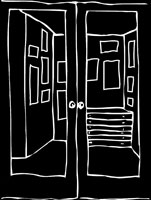
Colin Keefe, detail
America. The land of opportunity, the land of plenty. A place where
infinite vistas of landscape, space, and resources are cloaked in
mythologies of power, redemption and sublime awe. A place of boundless
optimism and rampant materialism. A country where relentless betterment,
reinvention of the self and individual happiness are seen as a birthright.
All of these overarching grand qualities are bound up with the ultimate
creative and willful expression that exists within the home and its
enveloping environment of city or suburb. The way we live now in our
communities is an insistent, pressing concern. Affordability of housing,
quality of life, relationship to the land and environment, as well
as availability of natural resources to support ever-expanding subdivisions
are all issues at stake.
Utopian thought has always played a major role in the American notion
of the home and community as it pertains to progress, fulfillment,
order, and organization. This is heavily reflected in the philosophical
underpinnings that feed the growth of cities and suburbs and their
subsequent schizophrenic relationship with nature and land. Nineteenth
century writers, artists and philosophers romanticized the connection
of humans to a vast, idyllic, wild western landscape that held within
its environs the keys to salvation and access to the sublime. In the
modern age, Le Corbusier developed The Radiant City, an urban plan
that was based on order, verticality, access to light and circumscribed
contact to patches of green, open space. In an ideal world, these
transparent, isolating spaces were supposed to alleviate the grime,
slums, poverty, overcrowding, and disorder associated with post-industrial
cityscapes. In present day America, the positive and negative stereotypes
associated with suburbia still retain its ever-present lock on the
culture and psyche. It is tidy, orderly, pruned, and cultivated. There
is light, space, safety, and room to spread out. Conversely, it is
also painted as soulless, homogenous, and narrow. From the pre-made
housing kits sold by Sears in the early 20th century, through the
idealized beginnings of post-war, mass-produced Levittown in Pennsylvania
and Long Island, NY, to the more recent proliferation of immense exurbs,
gated communities and theme neighborhoods based on the popular paintings
of Thomas Kinkade, suburbia is alive and well.
Critical Mass presents three artists: Robert Grunder, Colin Keefe,
and Lucas Monaco who utilize obsessive, repetitive, elegant drawing
and line as a way of reconciling and displaying the shifting spatial
notions and porous boundaries of what constitutes city and suburban
life in the present as well as its dreamy, fantastical underpinnings.
These three artists construct cities, communities, suburbs, and structures
that are as much about the constraints of geography, topography, mass
production, space, and land as they are meditations on the realities,
utopian ideals and fantasies of living between and pulling from the
opposing forces of civilization and nature. All three artists are
intensely concerned with how buildings and their supporting infrastructure
occupy, spread out, and displace mass and space. Furthermore, there
is an appealing friction that builds up in all of their drawings.
This arises from the homogeneous, endlessly repetitive, cookie-cutter
quality of their building clusters and roads that subtly pushes against
the delicate, tremulous, hand-made nature of their drawn and imagined
linear worlds set down on the abstract white nothingness of the paper.
This trio is also intrigued by an all-encompassing, aerial viewpoint
that can be brought down to the level of the minutely specific through
a focus on one building, lot or cul-de-sac within the larger expansive
picture. There is never any loss of the human element in their drawings,
even though it is masked by an endless, all-over breadth of construction.
The scale is always manageable and subject to close scrutiny with
a meandering eye.
Rob Grunder’s intimate, elegant drawings of mapped suburbia
on vellum are deeply rooted in the expressive power of line. Based
on real maps of Fairfax County, VA, the artist has edited out all
extraneous content and pared down his compositions to two or three
colors and the basic indirect and winding vectors of roads and building
clusters. Grunder’s drawings are very design oriented and flat,
as he prefers to deal with the trace and imprint of buildings on landscape
rather than the actual physical representation of the structure itself.
These transparent drawings convey an alignment with biology and living
systems run amok as they display a quality of unrestrained, almost
cancerous growth of transportation arteries, roads, and housing on
land. At the same time, these communities are strangely impersonal,
conceptual, and detached, as if they could exist anywhere. They are
not tied down by any profound attachment to land or environment, even
as they react to the challenges of topography and terrain. Space is
densely packed and hermetic. Nature has been squeezed out of the picture
to make room for more buildings and access routes. Grunder presents
a vision of normal suburban life that seems simultaneously familiar,
tough to navigate and destructive in its rambling replication.
The immense and airy drawings of Colin Keefe present semi-fantastical
cities that wander and amble over the great span of the paper in a
somewhat orderly disorder. His three-dimensional, transparent buildings
are akin to pieces on a game board in that, for all of their translucency,
they retain no intrinsic relationship to each other, except for sheer
physical proximity. The normal relationships that govern placement
and interconnectedness of buildings within a city are absent as each
structure stand alone and resolute within the pressing tremulous mass
of other, similar constructions. The transparency of these buildings
takes away their bulk, adding a level of fantasy and play to how Keefe
assembles his layout. The clear interiors also act like an obscuring
veil that hides meaning, function, and relevance of their appointed
task within his created world. Keefe is adept at integrating mass
and space within his drawings, making his city constructions more
organic and breathable than they appear to be in life. Like Rob Grunder’s
maps of suburban sprawl, Keefe’s delicate cities seem poised
for endless, steady growth, becoming a sober comment on the mixture
of fantasy and reality that exists in constructing life in the present.
The impenetrable, complicated, and dense drawn cities of Lucas Monaco
are based both on real, crowded urban sites, and their resulting topographical
make-up. They also possess an abstract, visionary quality that melds
land use and buildings into one parasitic organism. Monaco utilizes
aerial perspectives, strong thrusting sight lines and the blankness
of the white paper to mold his cities into floating worlds both of
and beyond the real. The repetitive and compact marks signify an infinite
vastness of construction, molded by the contours and crannies of terrain.
Monaco also exploits the emptiness of the white paper as it presses
on the habitable, human space that he has carved from its void. This
contested push and pull of nature vs. civilization speaks to an ever
present anxiety of control, organization, and dominion that does not
cease until every square inch of space is built on or held in reserve,
to be developed at a later time. These evocative drawings make manifest
the concerns of a modern society bent on pushing its store of limited
resources to the edge.
- Lisa Hatchadoorian
Lisa Hatchadoorian is currently Director of the Westby Gallery at
Rowan University, Glassboro, NJ. Previously, she was Associate Curator
for Pfizer Inc. She has curated many exhibitions that focused on drawing
and painting in the New York City area and has worked with artists
such as Max Gimblett, Jill Moser, and Sharon Louden. Ms. Hatchadoorian
received her MA in Curatorial Studies from Bard College in 2000.

Local school visit to the exhibition